
Before our son arrived, my husband and I spent weeks anxious about our 2BHK in Mumbai. Where would the crib go? What about all the gear we'd been gifted? How do you raise a baby in 900 square feet without losing your mind or your living room?
Two years later, I'll tell you: it's not only possible, it's actually quite beautiful. Small-space parenting forces you to be intentional. And intentional parenting, it turns out, is very often the best kind.
Buy Multi-Functional, Not More
The golden rule of small-space baby living: every item must earn its square footage. A playpen that doubles as a sleep space, a storage ottoman at the base of the crib, a foldable high chair that tucks against the wall — these are your best friends.
A compact foldable playpen with a bassinet insert can serve as your baby's sleep space in the early months and transition into a safe play area later — one item, two phases, no extra room needed.
Rethink the Nursery
You don't need a dedicated nursery room. A dedicated nursery corner works just as well — sometimes better. A small cot or co-sleeper beside your bed for the first 6 months, then transition to a corner of your bedroom or living room as they grow. Use a room divider or curtain if you want to create a visual boundary.
Vertical Storage Is Your Best Friend
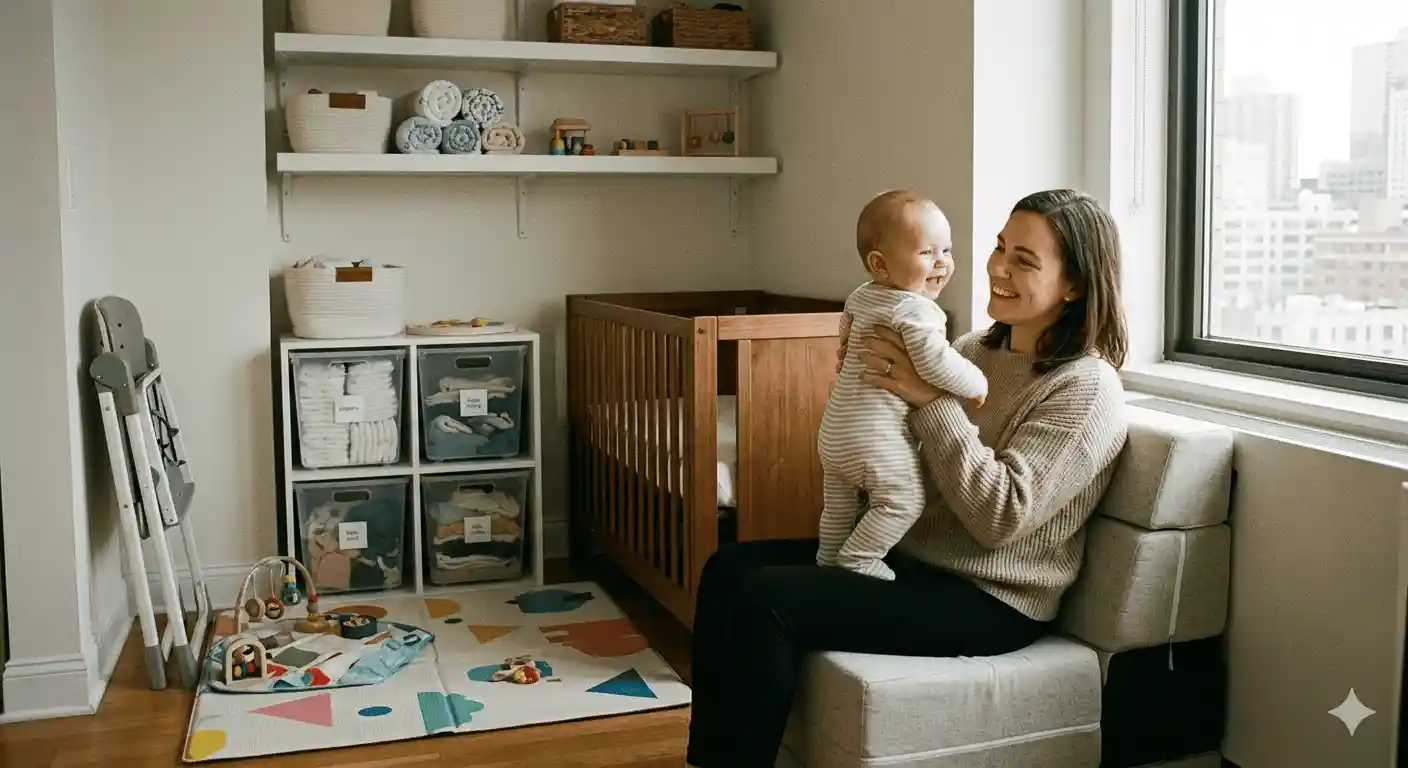
When floor space is limited, think upward. Floating shelves above the changing area, wall-mounted organisers for diapers and wipes, over-door pockets for bibs and burp cloths. A well-organised nursery storage unit with labeled bins keeps things tidy and accessible without taking up precious square meters.
A modular nursery storage system with removable baskets lets you reorganise as your baby's needs change — from diaper storage in month 1 to toy bins at month 12.
Manage the Toy Mountain
Toys multiply at an alarming rate. Implement a rotation system: keep only 6–8 toys out at any time, and store the rest. When you rotate them back in, your baby experiences them with fresh curiosity. This is actually better for development — it encourages deeper engagement with fewer objects rather than constant novelty-seeking.
Create Zones, Not Rooms
In a small apartment, your baby will live across all your spaces — and that's fine. A changing zone (corner of the bedroom with a mat and organiser), a feeding zone (a nursing chair by the window), and a play zone (a mat in the living area) is all you need. Clear zones mean less chaos even without separate rooms.
Embrace What Small Spaces Teach
Babies raised in close quarters tend to be adaptable, resourceful, and deeply connected to their families. They hear more conversations, are included in more activities, and rarely feel isolated. Close living breeds closeness — and that's a gift, not a compromise.
❓ FAQs
Q: What are the most space-saving baby items?
A: Foldable play mats, compact strollers, collapsible bath tubs, multi-functional playpens, and wall-mounted storage are among the most efficient choices for small apartments.
Q: Can a baby sleep in the same room as the parents?
A: Yes — room-sharing (not bed-sharing) is actually recommended by paediatricians for at least the first 6 months as it reduces SIDS risk and makes night feeds easier.
Q: How do I minimise toy clutter in a small home?
A: Use a toy rotation system, limit gifts to essentials, choose open-ended toys that grow with your child, and involve your child in tidying up from around 18 months onwards.
Q: When should I transition my baby from a bedside cot to their own space?
A: Most parents transition between 6–12 months. Follow your baby's cues and your family's comfort — there is no universal right time.
Q: How do I keep a small home clean with a baby?
A: Focus on easy-clean surfaces, machine-washable mats and covers, and quick daily tidy routines rather than occasional deep cleans. Baby-proofing also reduces the mess zone.