
Developmental Toys for Babies: An Age-Wise Guide to Boost Early Skills
Choosing the right toys for your baby isn't just about fun—it's a pathway to essential developmental milestones. From birth through toddlerhood, babies learn about their world through play. The right developmental toys for babies can stimulate cognitive growth, promote motor skills, and lay the foundation for lifelong learning. In this expert guide, we'll explore age-appropriate options, why they matter, and how to optimize your baby's playtime for every stage of early development.
Why Are Developmental Toys Important for Babies?
Developmental toys are more than entertainment; they're tools that encourage babies to explore, experiment, and learn. These toys are specifically designed to match babies’ evolving skills and interests, supporting progress in areas such as:
- Sensory development: Engaging sight, sound, touch, and sometimes smell or taste
- Motor skill refinement: Enhancing fine and gross motor abilities
- Cognitive growth: Building memory, cause-effect understanding, and problem-solving skills
- Social and emotional intelligence: Fostering bonds, empathy, and communication
What Makes a Toy 'Developmental'?
Developmental toys are characterized by features that:
- Encourage active engagement rather than passive observation
- Promote hands-on exploration and manipulation
- Are appropriate for the baby’s current age and stage
- Are made of safe, durable, non-toxic materials
Read on for our curated, age-wise breakdown of the best developmental toys for babies from birth through 24 months.
Newborn to 3 Months: Foundation of Senses
Developmental Focus
- Visual tracking
- Hearing and sound recognition
- Grasp reflex
Recommended Toys
- High-contrast black-and-white toys: Books, cards, or soft blocks that help develop vision
- Soft rattles: Easy to grasp and shake, stimulating hearing and touch
- Mobiles: Placed above the crib with bold patterns and gentle movement
- Unbreakable mirrors: Babies enjoy looking at faces, which fosters self-recognition and social skills
Expert Tips
- Supervise play at all times
- Talk and sing to your baby during play
- Rotate toys to maintain engagement
3 to 6 Months: Reaching, Grasping, and Smiling
Developmental Focus
- Hand-eye coordination
- Reaching and grasping
- Exploring cause and effect
Recommended Toys
- Soft cloth books: With crinkly pages and textures
- Teething rings: Safe, BPA-free materials for soothing and mouthing
- Play gyms: Mats with hanging toys encourage reaching, batting, and rolling
- Soft balls: Easy to grasp, squeeze, and roll
Expert Tips
- Allow tummy time with supervision to build neck and shoulder strength
- Encourage your baby to reach for toys just out of grasp
6 to 9 Months: Sitting, Exploring, and Babbling
Developmental Focus
- Sitting unassisted
- Object permanence
- Babbling and responding to sounds
Recommended Toys
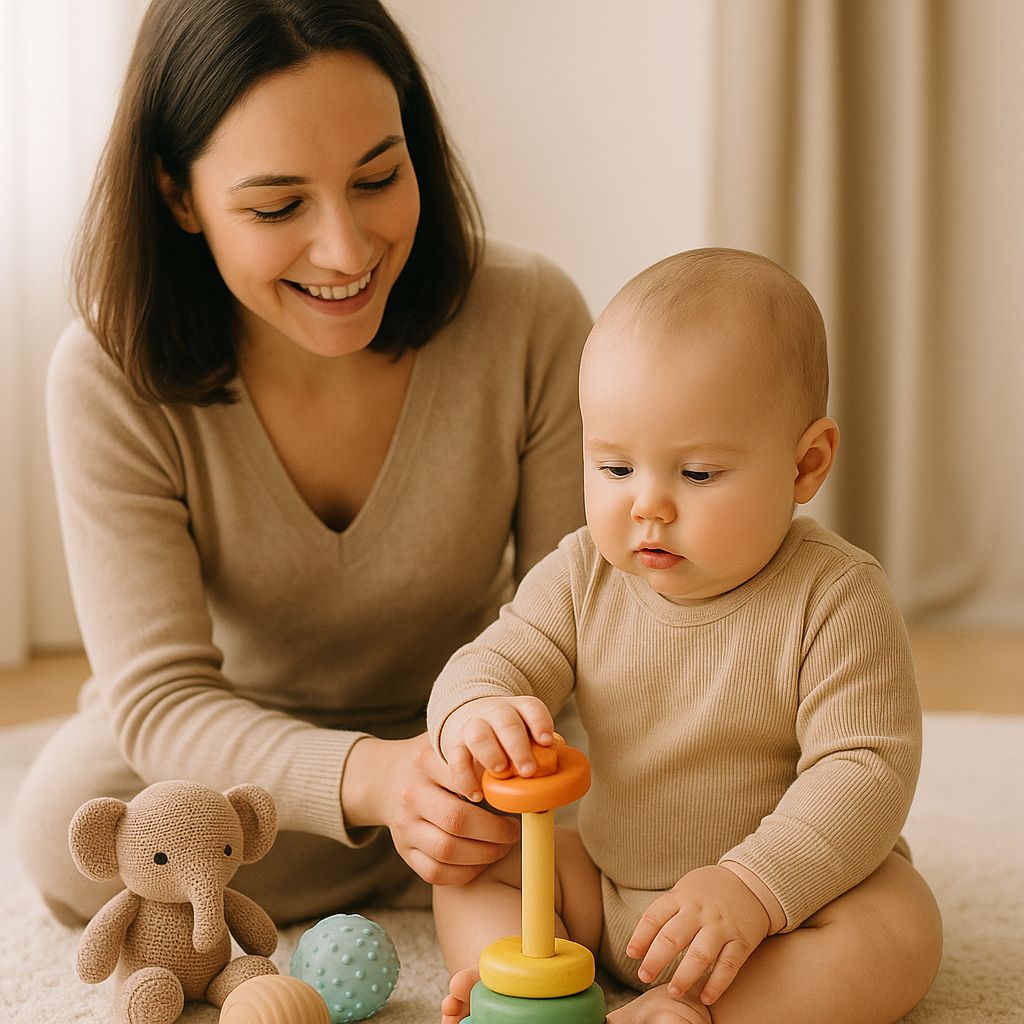
- Stacking rings: Promote hand-eye coordination and problem-solving
- Nesting cups: Teach size concepts and can be used in water play
- Textured balls: Encourage crawling and sensory exploration
- Musical instruments: Such as shakers and drums for cause-effect learning
Expert Tips
- Demonstrate how toys work, then let your baby try
- Use toys to encourage crawling and movement
9 to 12 Months: Crawling, Standing, and Problem-Solving
Developmental Focus
- Gross motor skills (crawling, pulling up, cruising)
- Fine motor skills (pincer grasp, finger dexterity)
- Imitation and early problem-solving
Recommended Toys
- Push and pull toys: Support standing and walking practice
- Shape sorters: Challenge problem-solving and matching
- Pop-up toys: Teach cause and effect
- Board books: Durable and interactive for early reading habits
Expert Tips
- Encourage your baby to imitate your actions with toys
- Celebrate problem-solving attempts, even if not successful
12 to 18 Months: Walking, Stacking, and Pretend Play
Developmental Focus
- Walking and climbing
- Building and stacking
- Simple pretend play
Recommended Toys
- Building blocks: Large, easy-to-handle blocks for stacking
- Push toys: Like shopping carts or animal walkers
- Simple puzzles: With large knobs or pegs
- Stuffed animals and dolls: Encourage nurturing and pretend scenarios
Expert Tips
- Join your child in building or pretend play to model new ideas
- Rotate toys to maintain interest and challenge new skills
18 to 24 Months: Imagination and Independence
Developmental Focus
- Imaginative play
- Problem-solving and matching
- Language development
Recommended Toys
- Role-play sets: Toy kitchens, tool kits, or doctor sets
- Ride-on toys: To develop coordination and gross motor skills
- Chunky puzzles: More pieces and complexity
- Art supplies: Crayons, washable markers, and finger paints for creativity
Expert Tips
- Encourage storytelling and narration during play
- Offer choices to support your child’s growing independence
General Safety Tips for Baby Toys
- Always choose toys labeled for your baby’s specific age range
- Inspect toys regularly for loose parts or damage
- Select non-toxic, BPA-free materials
- Ensure toys are easy to clean and disinfect
- Supervise play, especially with new or complex toys
How to Maximize the Benefits of Developmental Toys
- Rotate toys regularly: This keeps play fresh and supports diverse skill-building
- Engage in play together: Parental involvement enhances learning and bonding
- Observe your baby’s interests: Follow their lead to select toys that captivate attention
- Balance screen-free options: Prioritize tactile, manipulative toys over electronic screens in early years
Conclusion
Every baby develops at their own pace, but the right developmental toys for babies can provide targeted support for each stage. By choosing age-appropriate, safe, and engaging toys, you’re laying a foundation for curiosity, learning, and healthy growth. Remember, the best toy is one that invites your baby to explore, discover, and giggle—together with you.
For more expert guides and parenting resources, visit Growing Giggles—where every milestone is a reason to celebrate!