The moment your baby starts rolling over — usually around 4 months — the clock on baby-proofing starts ticking. By the time they crawl (6–9 months) and cruise along furniture (9–12 months), your home looks very different through a curious baby's eyes. Every cable, sharp edge, low cabinet, and open staircase is a potential hazard.
The good news: baby-proofing doesn't require a home renovation. It requires a methodical walk-through, a handful of smart products, and a few behavioral changes. Here's your complete, India-specific guide.
When Should You Start Baby-Proofing?
Start assessing your home by the time your baby is 3–4 months old. Complete essential fixes before they start crawling — usually by month 6. The most dangerous period is between 6–18 months, when babies are mobile but have no concept of danger.
Room-by-Room Baby Proofing Guide
Living Room
- Corner and edge guards: Coffee tables, TV units, and low shelves are at baby's exact head height during cruising. Soft foam corner guards are inexpensive and prevent serious injuries.
- Secure heavy furniture: Bookshelves, TV stands, and almirahs must be wall-anchored — climbing and toppling is a major cause of infant injuries in Indian homes
- Cable management: All electrical cords should be routed behind furniture or in cord covers — crawling babies are drawn to cables
- Remove low accessible items: Decorative items, remote controls, coins, and small objects from coffee tables
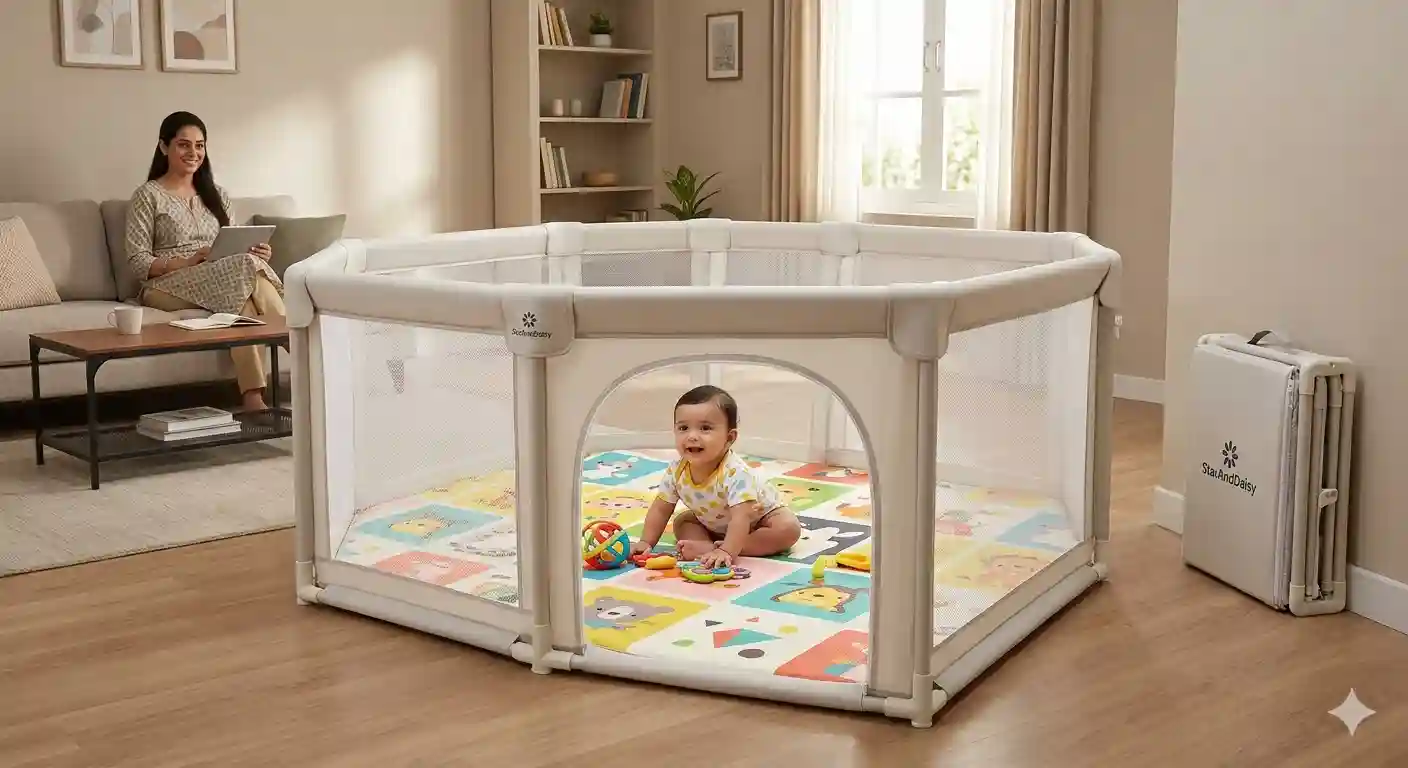
- Playpen or play yard: Setting up a defined safe zone gives baby a secure space to play unsupervised for short periods. StarAndDaisy's Playpen and Play Mat combos are a practical choice for Indian living rooms. See them here.
Kitchen
The kitchen is the single most dangerous room for a mobile baby. The rule is simple: keep babies out of the kitchen entirely while cooking.
- Install a door latch or baby gate at the kitchen entrance
- Lock all lower cabinets — store cleaning products, sharp utensils, and heavy items in upper cabinets only
- Use back burners on the stove when cooking; always turn pot handles inward
- Keep the refrigerator locked or the door handle covered
- Never leave a hot cup of chai or coffee on a surface within reach
Bathroom
- Always close the bathroom door — even 5cm of water in a bucket is a drowning risk for an infant
- Store all medicines, razors, and toiletries in locked cabinets
- Use a non-slip bath mat inside and outside the tub
- Set water heater temperature below 49°C to prevent scalding
- Keep the toilet lid down (add a toilet lock if needed)
Bedroom
- Move the crib away from windows and window blind cords — strangulation risk
- Lock or remove all medicines, cosmetics, and toiletries from bedside tables
- If using a fan, ensure it has a safety guard
- Cover all electrical sockets with safety plugs
- Block access under the bed — dust, small objects, and cable tangles accumulate there
Staircases (Critical in Indian Multi-Story Homes)
Staircase falls are among the most serious injuries for crawling babies. This is non-negotiable:
- Install a safety gate at both the top and bottom of all staircases before your baby can crawl
- Use hardware-mounted gates (screwed into the wall) at the top of stairs — far more secure than pressure-mounted
- Ensure the gate opening mechanism cannot be operated by a child
Brands like StarAndDaisy offer a baby safety equipment range including staircase gates and door locks designed for common Indian home configurations. Investing in certified, sturdy safety equipment is worth every rupee. Browse their safety range here.
Essential Baby Proofing Products Checklist
- ✅ Corner and edge guards for all sharp furniture
- ✅ Safety gates for staircase (top and bottom)
- ✅ Electrical socket covers
- ✅ Cabinet and drawer locks
- ✅ Furniture anchoring straps
- ✅ Door stoppers (to prevent finger pinching)
- ✅ Non-slip bath mat
- ✅ Toilet lid lock
- ✅ Play yard for a defined safe zone
Baby Proofing in Joint Family Homes
Joint family homes present unique challenges — multiple people coming and going, doors left open, different areas managed by different family members. A few tips:
- Brief all family members on the baby-proofing rules — safety gates left open defeat the purpose
- Consider which rooms the baby has access to and focus safety measures there
- Keep guest rooms and storage areas locked at all times
- Assign a "designated safe play zone" that all family members respect and maintain
- Remind older children about the importance of keeping small toys out of baby's reach
Frequently Asked Questions
At what age should I start baby-proofing my home in India?
Begin assessing and implementing safety measures when your baby is around 3–4 months old. Complete the main baby-proofing before they start crawling — typically around 6 months. The critical window for home safety is 6–18 months, when babies are highly mobile but have no sense of danger.
What are the most dangerous hazards in an Indian home for a crawling baby?
The top hazards are: open staircases, low electrical sockets, unsecured heavy furniture (toppling risk), kitchen access (hot liquids, sharp objects, cleaning chemicals), open water (buckets, bathroom), and small objects that can be swallowed. Address these first before anything else.
What safety gate is best for Indian staircases?
Hardware-mounted gates (screwed into the wall) are significantly safer than pressure-mounted gates for the top of stairs. Look for a gate that opens both ways, has a childproof latch, and is wide enough for your staircase. Always measure your staircase width before buying.
How do I baby-proof a rented apartment in India?
For rented homes, use pressure-mounted gates where possible (no wall damage), stick-on cabinet locks, socket covers, and furniture pads. Communicate with your landlord for permission to anchor heavy furniture — this is a genuine safety necessity. Document any wall anchoring with photos before and after.
Are Indian electrical sockets safe for babies?
Standard Indian electrical sockets (the round 3-pin type) can be covered with safety socket plugs or protected with sliding cover plates. This is one of the quickest and cheapest baby-proofing steps you can take. Replace any damaged or loose sockets before your baby becomes mobile — a crawling baby will find every accessible socket in your home.